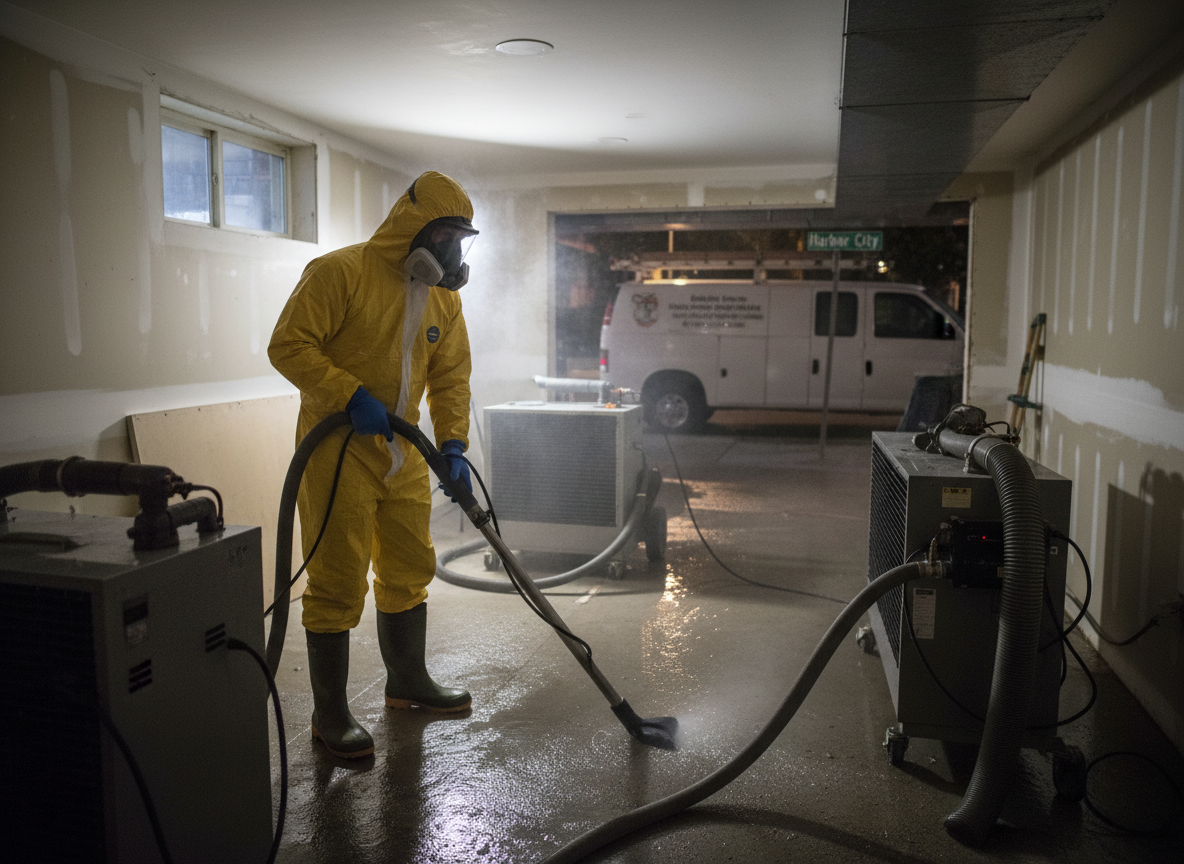
Harbor City's mild Mediterranean climate moderated by the ocean keeps humidity levels elevated even after a leak, so moisture lingers in wall cavities and under flooring longer than in inland Los Angeles spots. Homes near Harbor City Park and in Harbor Pines often have slab foundations and older plumbing runs that route under concrete, letting water travel unseen until it surfaces in adjacent rooms. Technicians must pull baseboards early and use moisture meters on both sides of shared walls to map the full extent before hidden saturation leads to secondary damage.
When a supply line fails in a Harbor Pines residence, water can migrate toward the lower elevation near Kaiser Permanente Harbor City, pooling against retaining walls or in garages. Extraction crews stage equipment on Sepulveda Blvd access points and route hoses to avoid blocking residential driveways during the 24-hour response window. Drying plans account for the steady ocean breeze that can either help or hinder dehumidifier performance depending on which direction windows face.
Los Angeles County code requires proper disposal of saturated porous materials once Category 2 or 3 water is confirmed, so crews separate and bag drywall and carpet on site rather than risking cross-contamination during transport. Edge cases include single-story ranch homes where water reaches the crawl space and travels under the entire footprint toward neighboring lots in Wilmington or Lomita. Continuous monitoring logs track humidity rebound that occurs overnight when the marine layer moves in.
Technician insight
In Harbor City, the thing that catches most people out with 24-hour water restoration near me is how the steady ocean-moderated humidity in Harbor Pines homes keeps drywall and underlayment wet days longer than expected, especially when water travels under slabs toward lower lots near Wilmington.
Burst supply line under kitchen slab
Water surfaced in a Harbor City home near Harbor City Park and traveled under the slab toward the garage. Extraction crews isolated the leak source, pulled affected flooring, and ran drying equipment for four days while the marine layer kept ambient moisture high. Daily meter checks confirmed levels returned to normal before any reconstruction began.
How it works
- 1
Arrival and Containment
Technicians reach the Harbor City address within the service window, shut off water if still flowing, and set up containment barriers to protect unaffected rooms.
- 2
Water Extraction
Standing water is removed using truck-mounted pumps and portable extractors suited for slab-on-grade construction common in the area.
- 3
Moisture Mapping
Infrared cameras and meters locate hidden moisture in walls and under flooring, noting paths influenced by the gentle slope toward San Pedro.
- 4
Drying and Monitoring
Air movers and dehumidifiers run continuously while daily readings confirm progress before the marine layer raises ambient humidity again.
- 5
Final Clearance
Once moisture levels match unaffected areas, equipment is removed and the site is left ready for any needed reconstruction.
Pricing
Upfront quotes provided after inspection; final cost depends on water volume, affected square footage, and drying duration required by local humidity.