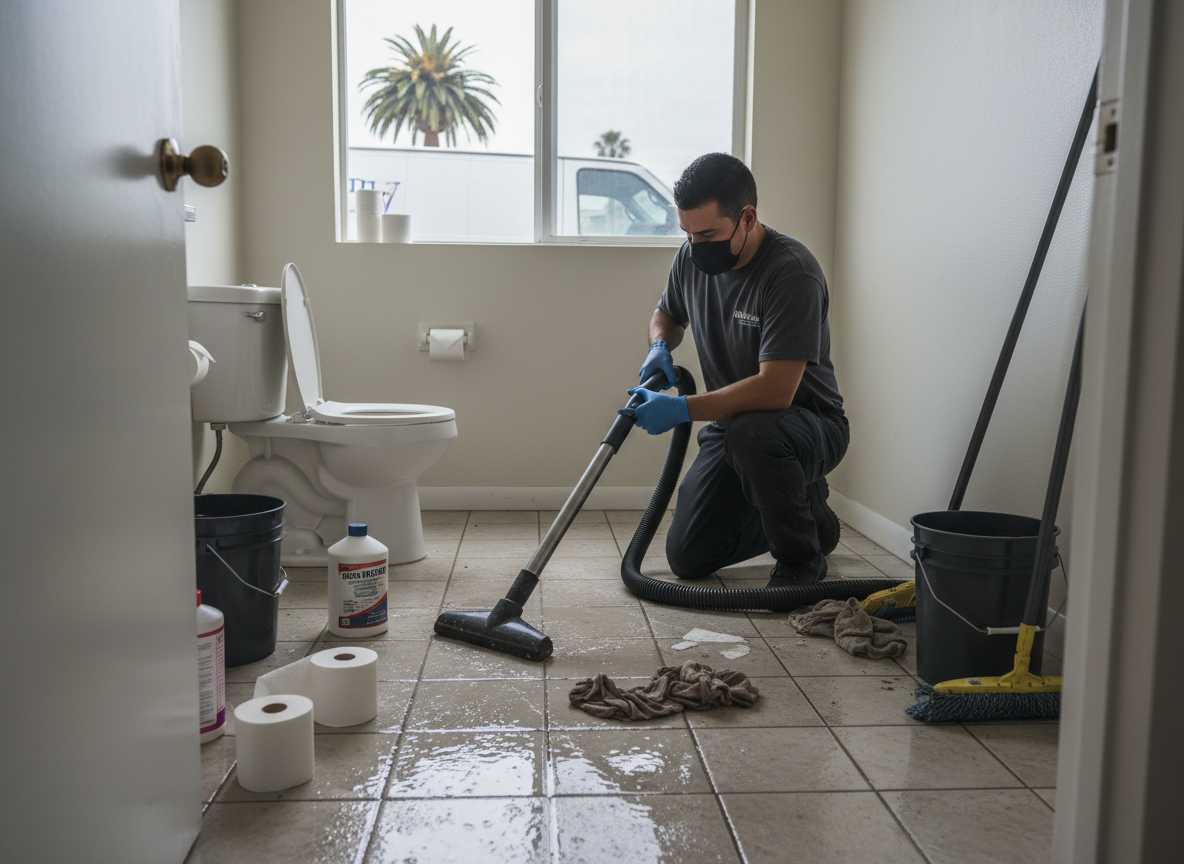
Toilet overflows in Harbor City often stem from aging cast-iron or galvanized lines common in 1950s-1970s homes throughout Harbor Pines and along Sepulveda Boulevard. When water backs up it quickly saturates vinyl or hardwood flooring and seeps into the subfloor, especially in single-story ranch houses where the slab sits close to grade. The mild Mediterranean climate moderated by the ocean keeps humidity elevated, so moisture does not evaporate on its own and mold can appear within 48 hours if extraction and dehumidification are delayed.
Technicians begin by isolating the source, shutting off the supply valve, and removing standing water with truck-mounted extractors rated for Category 3 black water. Affected baseboards and sections of drywall are cut away at least twelve inches above the water line to prevent hidden growth behind cabinets or in toe-kicks. In neighborhoods bordering Wilmington and Lomita, older homes frequently have limited access under kitchen islands or bathroom vanities, requiring targeted drying with air movers directed into wall cavities rather than whole-room fans.
After initial removal, moisture meters track readings in concrete slabs and wooden subfloors for several days. Los Angeles County health guidelines require disposal of porous materials that cannot be fully sanitized, such as carpet padding and particleboard vanity sides. Final clearance includes HEPA vacuuming and application of EPA-registered antimicrobials before new flooring is installed. Properties near Harbor City Park with mature landscaping often have irrigation lines running close to foundations, so crews also check for concurrent leaks that could re-wet the area after the toilet is repaired.
Technician insight
In Harbor City the thing that catches most people out with toilet overflow cleanup is the ocean-moderated humidity that keeps subfloors damp for days after extraction. Older Harbor Pines homes on raised foundations often have termite-damaged joists that wick water farther than expected, so we always pull baseboards on both sides of the wall and check the crawl space even when the spill looks contained to the bathroom.
Overflow Behind Vanity in Harbor Pines
A homeowner in Harbor Pines called after a toilet overflow soaked the bathroom floor and ran under a vanity into the hallway. We found water had wicked into the particleboard subfloor and reached the bedroom carpet pad. Extraction, removal of the vanity base, and three days of targeted drying prevented mold from reaching the adjacent bedroom wall shared with the next unit.
How it works
- 1
Source Isolation And Water Shutoff
Locate the overflow point, shut off the water supply, and protect unaffected rooms with plastic barriers.
- 2
Standing Water Extraction
Use commercial-grade pumps and wands to remove all visible water from flooring and under cabinets.
- 3
Affected Material Removal
Cut and dispose of saturated drywall, baseboards, and padding while preserving structural elements where possible.
- 4
Drying And Monitoring
Place air movers, dehumidifiers, and moisture meters; check readings daily until levels return to normal.
- 5
Sanitization And Clearance
Apply antimicrobial treatment, HEPA vacuum, and confirm the space is dry before reconstruction begins.
Pricing
Upfront quotes based on square footage affected, depth of water intrusion, and whether slab drying or material replacement is required.