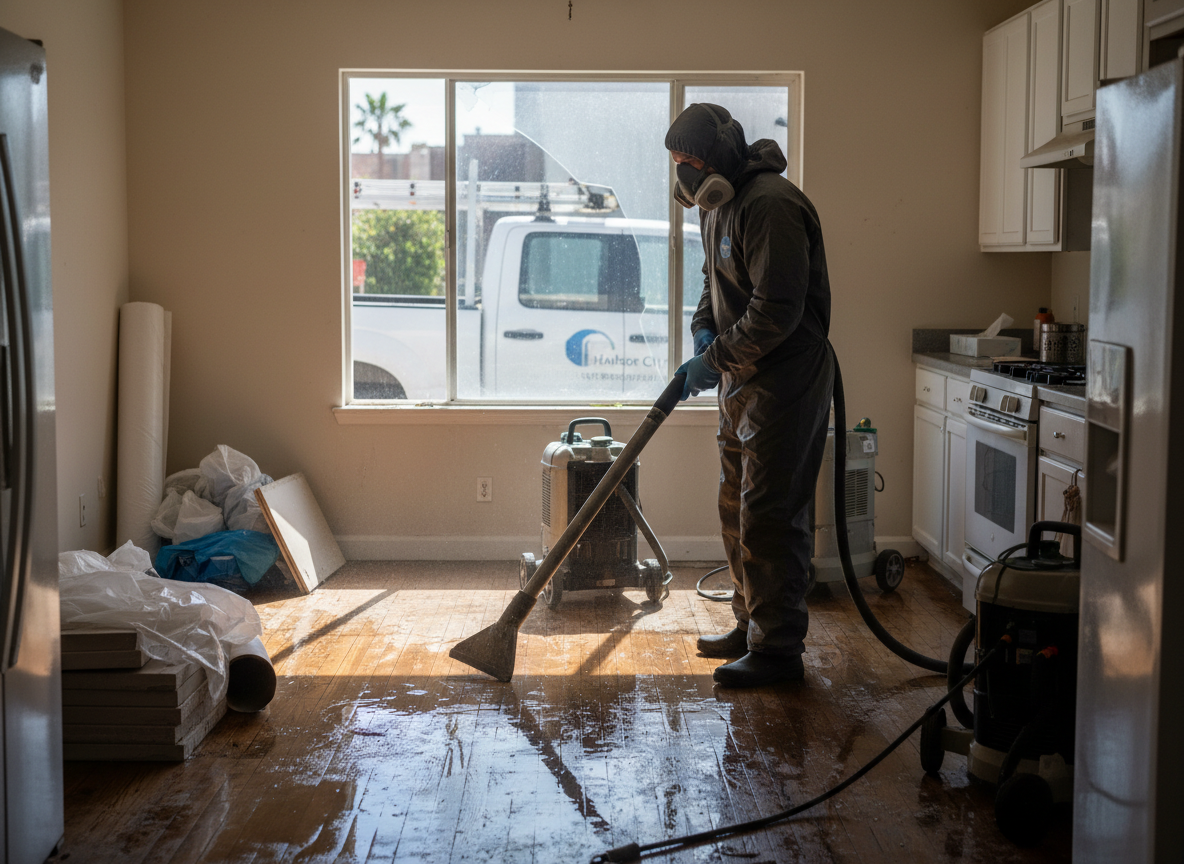
Water damage mitigation in Harbor City focuses first on stopping the source and removing standing water before it migrates into wall cavities or under slab foundations common in older Los Angeles County homes. The mild Mediterranean climate moderated by the ocean keeps relative humidity elevated even after the initial event, which extends drying times compared to inland neighborhoods and requires continuous moisture monitoring with meters rather than relying on fans alone. Properties near Harbor City Park often sit on slightly lower terrain that channels runoff from Lomita hills, so technicians check exterior grading and French drains before declaring an area dry.
Edge cases include hidden moisture behind stucco exteriors prevalent in Harbor Pines, where ocean salt air accelerates corrosion of metal lath and creates pathways for water to travel upward. Mitigation crews must separate saturated insulation from drywall without compromising load-bearing elements, then document every step for insurance adjusters who serve the greater Los Angeles area. Failure to address trapped moisture near Kaiser Permanente Harbor City can lead to recurring issues weeks later when temperatures fluctuate.
Local code requires proper disposal of contaminated materials and permits for structural drying equipment when work exceeds certain square footage thresholds. Technicians verify that dehumidifiers are sized correctly for the volume of air in single-story ranch homes typical of the neighborhood rather than using undersized residential units that leave pockets of dampness.
Technician insight
In Harbor City, the thing that catches most people out with water damage mitigation is how the ocean-moderated humidity lingers inside older stucco homes in Harbor Pines long after visible water is gone, turning a simple extraction job into repeated visits when homeowners skip daily meter checks.
Hidden Moisture After Kitchen Leak
Water from a supply line leak in a Harbor Pines residence traveled under the slab toward the living area. We mapped elevated moisture behind baseboards and extracted water before it reached neighboring units. Continuous drying equipment ran for five days until readings stabilized, preventing mold growth common in the local climate.
How it works
- 1
Source Identification
Locate and stop the water source using shutoffs and temporary containment while documenting conditions in Harbor City or Harbor Pines.
- 2
Water Extraction
Remove standing and trapped water with truck-mounted equipment suited to the mild coastal humidity that slows natural evaporation.
- 3
Moisture Mapping
Use meters and thermal imaging to identify affected materials in walls, floors, and sub-slabs common to local housing stock.
- 4
Drying and Monitoring
Deploy industrial dehumidifiers and air movers, then return daily to adjust settings until readings reach safe levels for the ocean-moderated climate.
Pricing
Pricing depends on the volume of water, affected materials, and drying duration required by local humidity levels.